Building New BRIMO Design System
Designing BRIMO’s operational design system from scratch, I led component creation, tokenization, documentation, and cross-team coordination to ensure consistency across design and development.
OVERVIEW
Role & Responsibility
Design System Lead - Identify, prioritize, and monitor tasks, progress of design, development, documentation across team members & conduct end-to-end audits of visual style
Timeline
May 2025 - August 2025
Platform
Mobile, iOS
This project was a revamp of BRIMO, the mobile banking application of Bank Rakyat Indonesia (BRI), one of the largest banks in Indonesia with millions of active users. The design system was created to support a large-scale mobile app redesign involving multiple modules and cross-functional teams.
ABOUT COMPANY
Bank Rakyat Indonesia (BRI) is one of the biggest state-owned banks in Indonesia, serving millions of retail and MSME customers nationwide. BRIMO is BRI’s flagship mobile banking application, used daily for transactions, payments, and financial management.
PROJECT GOALS
To build a scalable, consistent, and easy-to-maintain mobile design system that could be adopted quickly by designers and developers under tight deadlines.
How might we build a scalable and consistent mobile design system that can be adopted quickly by multiple teams working under tight deadlines?
IDEATION
Improving Design and Development Team Efficiency and Collaboration through Design System Implementation
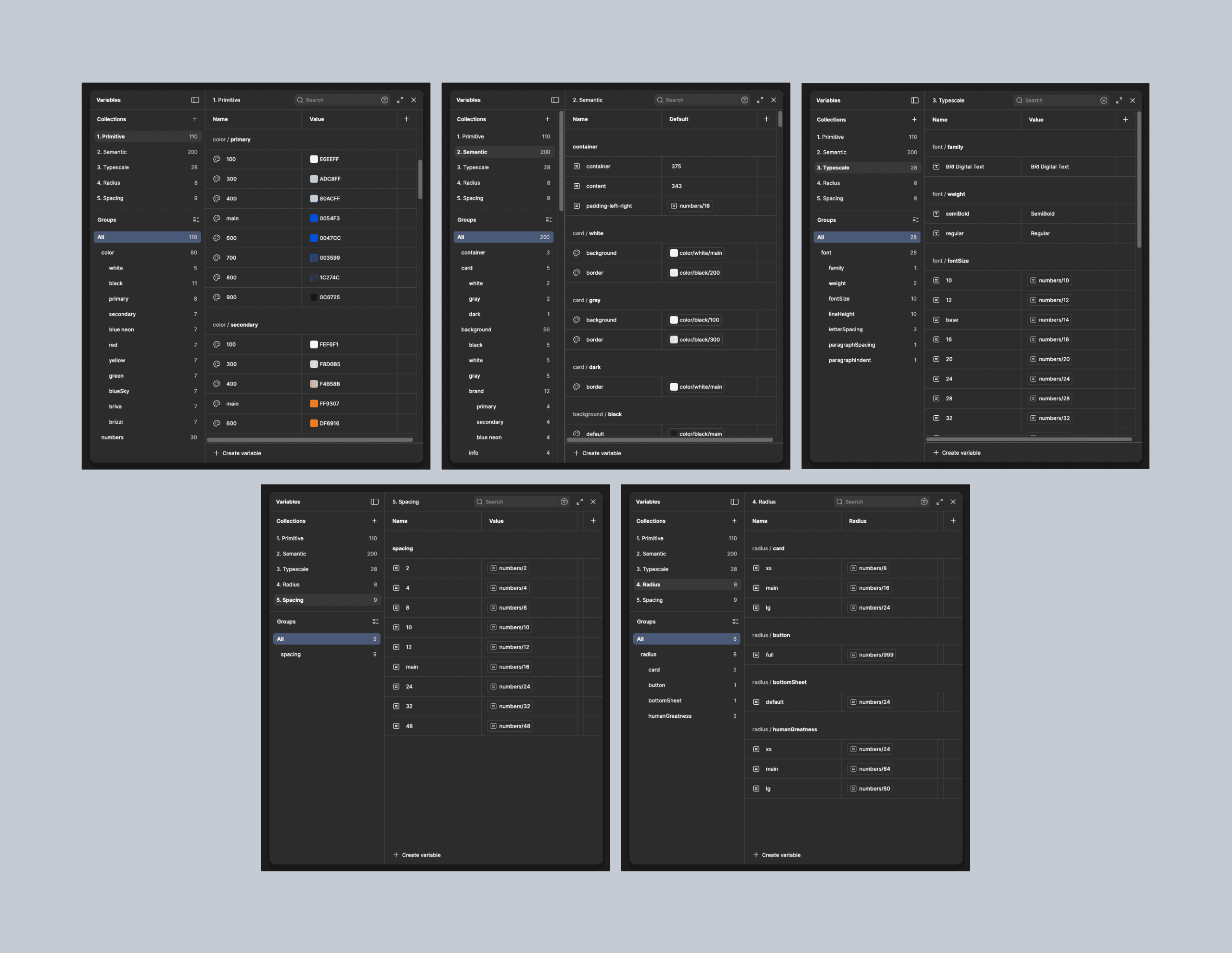
Instead of attempting to build a perfect design system upfront, I adopted a progressive approach by prioritizing core components first, releasing them early for immediate use, and continuously improving and expanding the system based on real feature requirements and feedback from ongoing implementation.
PROJECT STATUS
Design System Implementation Workflow
Together with one supporting designer, we successfully delivered a complete and usable design system within less than 3 months, despite the initial two-week setup deadline.
Coordinating Design and Development Daily
Because design system creation and implementation happened in parallel, I established a clear daily workflow:
Morning: Daily sync with ~20 designers to communicate updates
Daytime: Build and update components based on module needs
Afternoon/Evening: Sync with developers to explain changes and ensure correct implementation
This workflow ran continuously for almost 3 months.
Continuous Launch and Iteration
The design system was rolled out gradually to design teams and tested in real modules, allowing immediate iteration based on developer feedback and continuous refinement rather than relying on a single final release
RESULT
Design System Completion
By August, the design system reached 100% completion and was fully handed over to BRI’s internal design team for long-term maintenance and scaling.
Design and development workflows became more efficient, with fewer revisions and faster handoff compared to the initial phase before the design system was established.
Adoption Rate
The system was actively used by more than 20 designers and 15 developers across 20 different modules, demonstrating strong adoption and trust in the system.
Consistency Improvement
UI inconsistencies across modules were significantly reduced, resulting in a more cohesive user experience for the BRIMO application.
Faster Design & Development Flow
Design handoff became clearer, revisions decreased, and implementation speed improved compared to the early phase before the system existed.